In wastewater, sulfur-containing compounds can exist in various forms. Among them, sulfide, H₂S, and sulfate are concepts easily confused when analyzing water quality and operating treatment systems. Although interconnected in the sulfur transformation process, these three terms are not entirely equivalent in terms of chemical nature, state of existence, and their impact on the system. Correctly distinguishing them helps evaluate monitoring results, identify odor generation risks, and select appropriate control measures.
Sulfide is a term for sulfur forms with an oxidation state of -II. In wastewater, dissolved sulfide is typically evaluated through the equilibrium between H₂S, HS⁻, and S²⁻. In the typical pH range of wastewater, H₂S and HS⁻ are the two predominant forms, while the free S²⁻ ion accounts for a very small proportion. The scope of sulfide determined in analysis results also depends on the applied test method.
Sulfide may be inherently present in the influent wastewater or formed during the decomposition and conversion of sulfur-containing compounds. A common mechanism is sulfate-reducing bacteria generating sulfide under suitable anaerobic conditions.
This process is usually notable in:
When sulfide appears, the potential for H₂S formation and dispersion must be considered. However, the extent of gas generation depends not only on the sulfide content but is also influenced by pH, temperature, water turbulence, and operating conditions.
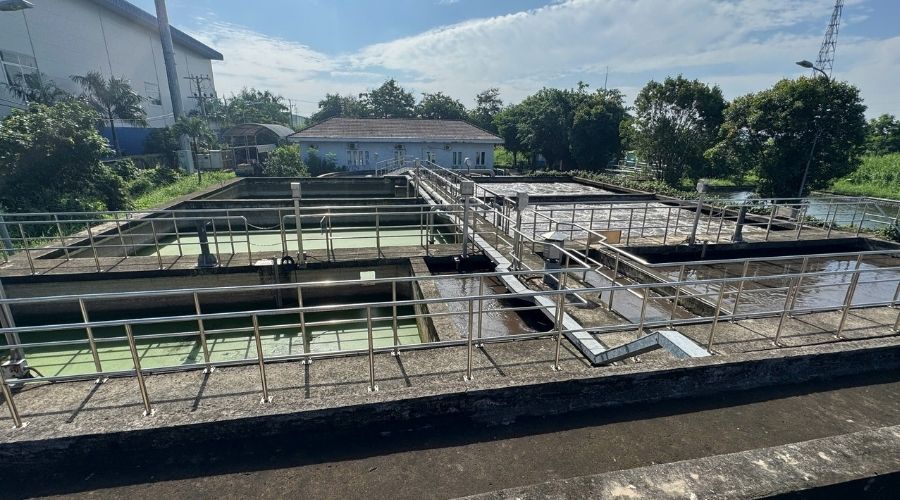
Sulfide in wastewater
The crucial differences among these three forms lie in their chemical nature, how they exist in water, and their impacts on the treatment system.
|
Criteria |
Sulfide | H₂S | Sulfate |
|
Nature |
Sulfur forms with oxidation state -II; scope depends on state of existence and analytical method | Hydrogen sulfide, belongs to the sulfide equilibrium system | SO₄²⁻ ion, sulfur with oxidation state +VI |
|
State of Existence |
May include H₂S, HS⁻, S²⁻, and other sulfide forms |
Dissolved in water or exists as a gas |
Primarily exists as a dissolved ion |
|
Characteristics |
Related to the risk of H₂S formation and dispersion | Has a rotten egg odor at low concentrations; H₂S gas is highly toxic when accumulated | Does not directly cause a rotten egg odor like H₂S |
| Treatment Significance | Monitoring sulfide and the risk of gas generation | Controlling odor, toxicity, and operational safety | Evaluating wastewater composition and the potential for sulfate reduction |
H₂S belongs to the sulfide equilibrium system in water but must be distinguished from the "sulfide" parameter determined by analytical methods. Meanwhile, sulfate (SO₄²⁻) is a sulfur form with an oxidation state of +VI and has distinctly different chemical properties.
When reading an analysis result sheet, operators should note how the parameter is recorded. For instance, the notation "Sulfide (S²⁻)" on a test report does not mean all the sulfide in the water exists as free S²⁻ ions.
Additionally, one must distinguish between total sulfide and dissolved sulfide based on the scope of the test method. The sulfide concentration measured in a water sample cannot be directly used to deduce the H₂S concentration in the air.
In a wastewater system, sulfur forms can interconvert through chemical reactions and microbial activity. These processes are influenced by redox conditions, pH, and wastewater characteristics.
Under suitable anaerobic conditions, sulfate-reducing bacteria can use SO₄²⁻ as an electron acceptor and generate sulfide during the conversion process. This mechanism can lead to the appearance of H₂S in collection pipes, pump pits, or areas with long-accumulated sludge.
However, wastewater containing sulfate will not inevitably generate H₂S. The sulfate reduction process also depends on the substrate source, the presence of competing electron acceptors, redox conditions, and the activity of the sulfate-reducing bacteria group. Therefore, a high sulfate content does not mean H₂S will certainly be generated in the system.
In water, H₂S and HS⁻ exist in a state of equilibrium:H₂S ⇌ H⁺ + HS⁻
pH is a crucial factor determining the ratio between these two forms.
Therefore, two wastewater streams with the same sulfide concentration can still differ in their risk of generating H₂S gas. However, adjusting the pH does not mean all sulfide has been removed from the wastewater.
In environments with appropriate oxidizing conditions, sulfide can be converted into elemental sulfur or sulfur forms with higher oxidation states, including sulfate. This process can occur through chemical reactions or the activity of sulfur-oxidizing bacteria. The final product depends on the reaction conditions, oxidizing agents, and wastewater characteristics.
Sulfide is not just a parameter on an analysis sheet. When appearing under adverse conditions, it can be linked to many issues during wastewater collection and treatment, particularly H₂S gas generation, structural corrosion, and impacts on biological activities.
H₂S has a characteristic rotten egg odor at low concentrations. When the gas escapes from wastewater, the odor can appear at pump pits, storage tanks, pipes, or treatment areas.
Notably, H₂S is a toxic gas. In confined spaces or poorly ventilated areas, the gas can accumulate to dangerous levels. At high concentrations, the ability to detect it by smell can diminish or disappear; therefore, never rely on smell to determine if a working area is safe.
For areas at risk of H₂S generation, there must be appropriate measures for gas assessment, ventilation, and safety control. Do not enter confined spaces without implementing the necessary safety precautions.
If H₂S has already dispersed into the gas phase, control should be approached through exhaust gas treatment rather than just treating sulfide in the water. You can refer to Dai Nam's article "The Most Effective H₂S Exhaust Gas Treatment Methods Today."
Another impact of H₂S is the risk of material corrosion. On moist surfaces exposed to air, H₂S can be biologically oxidized to form sulfuric acid. This acid can corrode concrete and reduce the lifespan of certain structural components.
The extent of the impact depends on the materials, exposure environment, and operational duration. Areas frequently generating H₂S must be considered from material selection to gas control plans.
When sulfide accumulates to inhibitory concentrations—especially the undissociated H₂S portion—the activity of certain microbial groups in the wastewater treatment system can be affected.
The inhibitory capacity depends on sulfide concentration, pH, the ratio of undissociated H₂S, and the microbial system's level of adaptation. Therefore, when biological treatment efficiency declines, multiple operational parameters should be checked collectively rather than concluding the cause based solely on odor.
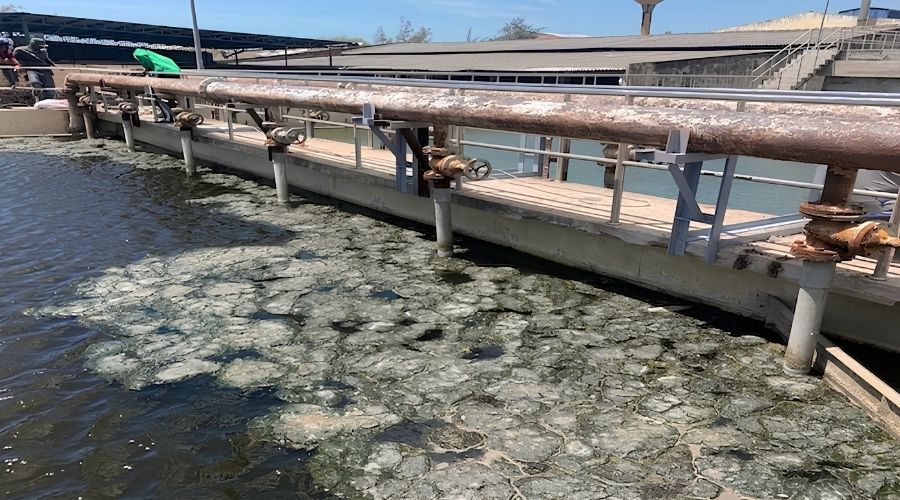
H₂S causes corrosion risks in wastewater treatment systems
Besides operational issues, sulfide is a parameter with regulated limits in national technical regulations on wastewater.
Two notable regulations include:
In these regulations, the parameter is recorded as "Sulfide (S²⁻)". This is a notation serving wastewater quality assessment and does not mean all sulfide in the sample exists as free S²⁻ ions.
The limit values for the sulfide parameter are regulated as follows:
| Regulation | Column A (mg/L) | Column B (mg/L) | Column C (mg/L) |
| QCVN 40:2025/BTNMT | 0.2 | 0.5 | 1.0 |
| QCVN 14:2025/BTNMT | 0.2 | 0.5 | 0.5 |
These values must be cross-referenced with the corresponding limit tables in each regulation. Determining the applicable limit column also depends on the emission source type, discharge conditions, and related regulations.
When cross-referencing analysis results, it is necessary to correctly identify the regulation, table, and limit column applicable to each case, while also considering relevant transitional provisions.
It is necessary to distinguish between wastewater quality limits and monitoring obligations. The fact that a parameter has a regulated limit does not mean every facility must conduct periodic monitoring for that parameter. The monitoring list and frequency for each project must be based on the environmental license and applicable legal regulations.
Furthermore, sulfide, sulfate, and H₂S cannot automatically be substituted for one another when comparing analysis results against regulatory limits.
Sulfide, H₂S, and sulfate are linked in the sulfur transformation process but differ in their characteristics and impacts on wastewater.
Among them, H₂S is the form requiring special attention regarding the risks of toxic gas generation, odors, and structural corrosion. Sulfate does not directly possess these characteristics but can become a source of sulfide formation under suitable reducing conditions.
When evaluating wastewater containing sulfide, analysis results must be combined with pH, operating conditions, and system characteristics. This approach helps correctly identify the causes, control H₂S generation risks, and select appropriate treatment solutions.
Dai Nam provides surveying, consulting, designing, construction, and operation services for wastewater treatment systems tailored to the characteristics of each emission source. Correctly determining the pollution components and operating conditions is the foundation for developing a treatment plan that meets the technical requirements of the project.