TSS and turbidity are two indicators commonly found in wastewater analysis results, used to evaluate the presence of suspended particulate matter in water. These parameters directly affect the quality of receiving water sources, wastewater treatment efficiency, and the ability to comply with current environmental regulations.
In reality, many businesses often focus on COD, BOD, or Ammonia without truly paying attention to TSS and turbidity. However, these are the parameters that frequently cause effluent to fail requirements, reduce disinfection efficiency, and create various problems during treatment system operation. So, what are TSS and turbidity, how are they related, and what are the effective control solutions?
TSS (Total Suspended Solids) is the total amount of suspended solids existing in water that are not completely dissolved. These substances can be organic or inorganic particles of various sizes and are typically measured in mg/L.
In wastewater, TSS can originate from soil, sand, mud, organic residue, fibers, microorganisms, algae, or particulate matter generated during production. Depending on the industry, the composition and concentration of TSS will vary significantly.
TSS is an important indicator for assessing the pollution level of wastewater. When the TSS concentration increases, the amount of suspended residue in the water is higher, putting pressure on downstream treatment facilities such as settling tanks, filtration systems, or the disinfection stage.
If TSS reflects the mass of suspended solids, turbidity reflects the ability of particulate matter in the water to obstruct or scatter light.
The more suspended particles water contains, the harder it is for light to pass through, resulting in higher turbidity. Turbidity is typically measured in NTU (Nephelometric Turbidity Unit) using specialized measuring devices.
Common causes of increased turbidity in wastewater include mud, undecomposed organic matter, microorganisms, fine colloidal particles, or undissolved grease. Thanks to its ability to be measured quickly and provide almost instantaneous results, turbidity is often used to monitor water quality trends during the operation of treatment systems.
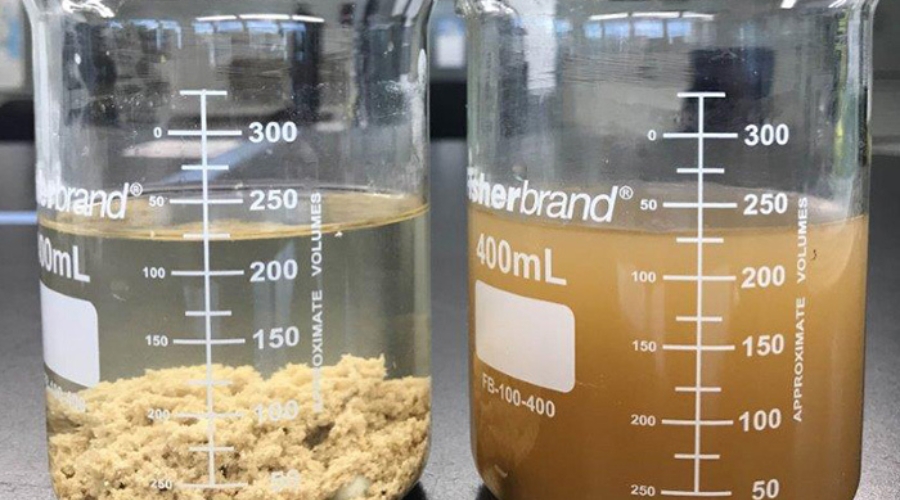
TSS and Turbidity in wastewater
TSS and turbidity are quite closely related because both are affected by the presence of suspended particulate matter in the water.
Normally, as the TSS concentration increases, turbidity also tends to increase. This is why many monitoring systems use turbidity as a quick indicator to assess changes in water quality.
However, these two indicators are not exactly the same. TSS reflects the mass of suspended solids in the water, while turbidity reflects the water's ability to obstruct light. TSS is determined by filtering and weighing the mass, whereas turbidity is determined by a specialized measuring device.
In some cases, water may have high turbidity but TSS is not excessively large if there are many small-sized colloidal particles or microorganisms. Therefore, assessing water quality based on only one of these two indicators often does not provide a complete picture.
TSS and turbidity appear in almost all types of wastewater, from domestic to industrial.
Domestic wastewater: The main sources come from leftover food, paper, organic residue, and solid waste generated during daily use.
Food processing and seafood industries: TSS often comes from raw material residue, starch, grease, fish/meat scraps, or suspended organic matter.
Textile dyeing industry: Turbidity is often generated from fibers, precipitated dyes, and incompletely reacted chemicals.
Livestock wastewater: Contains large amounts of organic matter, manure, and excess feed, significantly increasing TSS and turbidity in the water.
.jpg)
Note the sources of TSS in wastewater
When TSS and turbidity increase, the quality of the receiving water source is significantly degraded, leading to many negative environmental impacts.
Reduced Light Transmission
A large amount of suspended residue makes the water murkier, limiting the ability of light to penetrate the lower water layers. This directly affects the photosynthesis process of aquatic plants and algae.
Impact on Aquatic Ecosystems
Sediment particles can adhere to fish gills or settle on the growth areas of benthic organisms, degrading living conditions and affecting the development of aquatic ecosystems.
Decreased Disinfection Efficiency
When the amount of suspended residue remains high, pathogenic microorganisms can be shielded inside the sediment particles, reducing the effectiveness of chlorination or UV disinfection. This is why many treatment systems still detect microorganisms in the effluent even though the disinfection stage is operating normally.
TSS is a controlled parameter in many current wastewater regulations, such as QCVN 14 (domestic wastewater), QCVN 40 (industrial wastewater), or QCVN 62 (livestock wastewater). However, it is also a parameter that frequently exceeds limits in the food, seafood, livestock, and textile dyeing industries.
Inadequate settling efficiency: When the wastewater flow increases suddenly or the retention time is insufficient, flocs that have not yet settled are carried out of the system by the water flow.
Biological system issues: Phenomena such as floating sludge, sludge bulking, or unstable microbiological growth can increase effluent TSS.
Chemical imbalances: Using inappropriate PAC, Polymers, or suboptimal pH adjustment will reduce coagulation and flocculation efficiency, making the sludge separation process less effective.
In addition to affecting effluent quality, high TSS increases the amount of generated waste sludge, adding load to settling tanks and filtration systems. For membrane-based technologies like MBR or UF, a high TSS concentration increases the risk of fouling, reduces flow rates, and incurs equipment cleaning costs.
.jpg)
Pay attention to regulations before discharging wastewater into the environment
Depending on the wastewater characteristics and effluent quality requirements, businesses can apply one or a combination of different treatment methods.
This is a group of solutions used in the initial stage to remove large-sized particles before the wastewater enters subsequent treatment stages. Common facilities include bar screens, grit chambers, primary settling tanks, secondary settling tanks, and sand filtration systems. Removing residue right from the start helps reduce the load on downstream treatment units and improves the overall operating efficiency.
For small particles or those existing in colloidal form, physico-chemical methods usually yield higher efficiency. Common technologies include coagulation, flocculation, DAF (Dissolved Air Flotation), and physico-chemical settling. This is a widely applied solution for food, seafood, paper, textile dyeing wastewater, and many other industries with high TSS content.
When effluent quality requirements are high or water reuse is needed, membrane technologies such as MF, UF, or MBR are often chosen to remove most of the remaining suspended solids after traditional treatment stages.
TSS and turbidity are two important indicators that help evaluate wastewater quality as well as the operating efficiency of the treatment system. Although closely related, these two parameters reflect different characteristics of water and need to be monitored simultaneously for a more complete view of the pollution level.
Effectively controlling TSS and turbidity not only helps effluent meet environmental regulations but also contributes to improving operational efficiency, reducing treatment costs, and increasing the stability of the entire wastewater treatment system.