Amusement parks can receive from a few hundred to thousands of visitors per day, while integrating many areas such as restaurants, food courts, restrooms, service areas, accommodations, and water-using amenities. This characteristic causes the flow rate and pollution load of the wastewater to fluctuate significantly between weekdays, weekends, peak seasons, or holidays.
Therefore, an amusement park wastewater treatment system must not only meet post-treatment water quality requirements but also be adaptable to fluctuations in flow rate, pollution load, and actual operating conditions. Properly surveying the emission sources, determining the capacity, and selecting the appropriate technology from the beginning plays a crucial role in the long-term operational efficiency of the system.
Wastewater at amusement parks primarily bears the characteristics of domestic wastewater, but the emission sources are often more diverse than those of a standard residential building. Depending on the scale and operating model, wastewater can originate from:
Among these, wastewater from restrooms usually contains organic matter, Ammonia, Nitrogen, Phosphorus, suspended solids, and microorganisms. Kitchen wastewater contains additional grease, food scraps, and a relatively high organic load. This wastewater stream needs to be collected and properly grease-separated before being directed to the common treatment system to limit impacts on pipes, equipment, and the biological treatment process.
For swimming pools, water parks, landscape lakes, or other water-using amenities, it is necessary to separately determine the generation characteristics and collection plan for each project. It should not be assumed that all these water streams share the same characteristics and can be treated like domestic wastewater.
.jpg)
Wastewater from amusement activities
Because it originates from multiple areas, amusement park wastewater often contains characteristic polluting components such as BOD, COD, TSS, Ammonia, Nitrogen, Phosphorus, and microorganisms. For projects with restaurants or food courts, grease and food scraps are also components requiring special attention.
The wastewater composition can vary significantly depending on the service structure of each project. Amusement parks with large-scale food courts often generate higher COD, BOD, and grease loads. Meanwhile, densely populated areas can increase the loads of Ammonia, Nitrogen, and microorganisms from restroom wastewater. Therefore, two amusement parks with equivalent visitor numbers will not necessarily have the same wastewater flow rate and pollution load.
Another important characteristic is temporal fluctuation. The number of visitors on weekends, during the summer, or on holidays can be significantly higher than on weekdays. As visitor numbers increase, both the wastewater flow rate and the pollution load entering the system can increase accordingly. This is a factor that must be considered during design so that the system maintains stable treatment efficiency under various operating conditions.
Post-treatment water quality is one of the crucial bases for selecting technology and calculating the system. For the project's domestic wastewater, the applicable environmental technical regulations and bases need to be determined according to the object, receiving source, time of application, and relevant environmental requirements of each project.
During the design process, parameters such as BOD, COD, TSS, Ammonia, Total Nitrogen, Phosphorus, and microorganisms need to be considered based on the inlet wastewater characteristics and the required output water quality. In cases where treated water is reused for irrigation, cleaning, or other purposes, the system may need supplementary treatment stages appropriate for the actual usage requirements.
According to QCVN 14:2025/BTNMT, some main parameters for domestic wastewater of projects and facilities are stipulated as follows:
| Parameter | Level A | Level B | Level C |
| BOD₅ (mg/L) | ≤ 30 | ≤ 35 | ≤ 40 |
| COD (mg/L) | ≤ 80 | ≤ 90 | ≤ 100 |
| TSS (mg/L) | ≤ 50 | ≤ 60 | ≤ 70 |
| Ammonia (mg/L) | ≤ 6 | ≤ 8 | ≤ 10 |
| Total Nitrogen (mg/L) | ≤ 25 | ≤ 30 | ≤ 40 |
| Total Coliform (MPN or CFU/100 mL) | ≤ 3,000 | ≤ 5,000 | ≤ 5,000 |
The applicable Level A, B, or C must be determined according to the receiving source and environmental requirements of each project. Correctly determining the output requirements right from the design stage helps avoid selecting inappropriate technology or having to renovate and add structures after the system has been put into operation.
The system's capacity should not be determined simply based on the area of the amusement park. Calculations need to consider the number of visitors, number of staff, operating hours, water usage demand, scale of the food service area, accommodation area, and wastewater-generating amenities.
Besides the average daily flow, the flow rate during peak times also needs to be evaluated to select the appropriate tank volumes, equipment capacity, and operating modes. Simultaneously, the pollution load must also be considered because the overload level of biological structures depends not only on the water volume but is also related to the amount of pollutants introduced into the system within the same timeframe.
For example, an amusement park receives an average of 2,000 visitors/day, but on weekends or holidays, this can increase to 3,000–4,000 visitors/day. If the system is calculated based solely on the average visitor count without considering the peak period, the risk of overload will increase when visitor numbers spike. The figures above are for illustrative purposes only; actual capacity must be determined according to the conditions of each project.
Amusement Park Wastewater Treatment Process
Depending on wastewater composition, capacity, and output water quality requirements, each project may apply different technologies. A basic treatment system typically includes the stages shown in the following diagram:
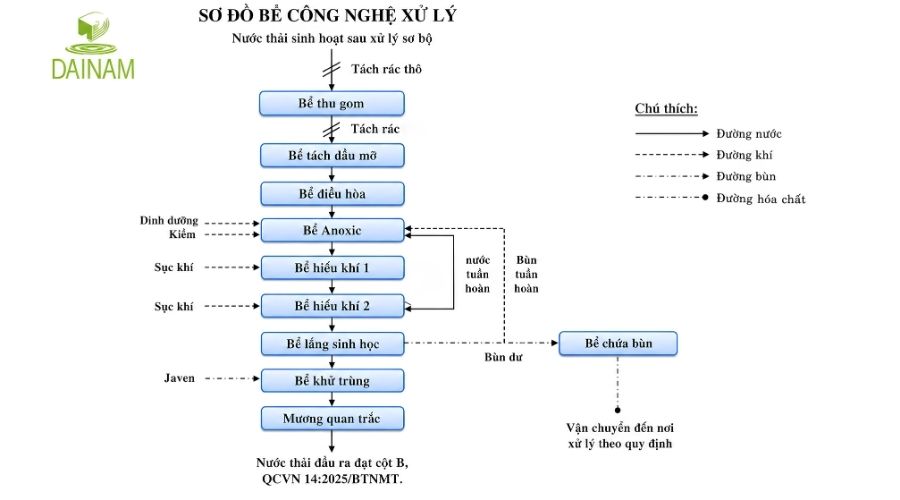
Domestic wastewater treatment diagram according to the latest regulations
Wastewater from various areas is collected into the system, where large-sized trash is removed to limit pipe blockages and protect equipment. Specifically, wastewater from the kitchen area must undergo grease separation before mixing with the common wastewater stream.
The equalization tank plays an important role for amusement parks because it helps balance the flow rate and pollution concentration before the water is transferred to the biological stage. After the biological treatment process, sludge is separated from the water, and the water continues through a disinfection stage before discharge or undergoes supplementary treatment if there is a reuse demand.
A suitable system for an amusement park must not only treat water to meet requirements but also adapt to changes in visitor numbers, limit odor and noise, and be convenient for operations.
Fluctuations occur not only between times of the day but can also extend seasonally. Some amusement parks have low visitor numbers on weekdays but see sharp increases on weekends, in the summer, or during holidays.
When visitor numbers are low for extended periods, the wastewater flow and organic matter supplied to the microbial system also decrease. Conversely, when visitor numbers spike, the system may have to receive a massive load in a short time. Therefore, the design and operational plan must account for both off-peak and peak periods rather than just catering to a fixed capacity level.
Restaurants, food stalls, and food courts can generate significant amounts of grease and food scraps. If not effectively separated, grease can penetrate deep into the system, cling to pipes and equipment, and affect the biological treatment process.
Grease traps must therefore be selected according to the actual flow of the kitchen, and accumulated grease and solids must be periodically removed. Good control right at the source significantly reduces the load on downstream treatment stages.
Wastewater treatment systems in amusement parks might be located relatively close to guest service areas. Therefore, in addition to output water quality, odor and noise are also factors that must be controlled.
Tank placement, ventilation, and odor collection and treatment in necessary areas should be considered right from the design stage. Air blowers, pumps, and mechanical equipment also need to be arranged appropriately to limit impacts on sightseeing and service areas.
The space allocated for the system must ensure the ability to inspect equipment, suction sludge, clean tanks, and perform periodic maintenance. Minimizing the area too much without providing access paths can make future repairs difficult.
For continuously operating amusement parks, the design plan must also consider maintenance or equipment replacement while minimizing the impact on the overall operation of the facility.
.jpg)
System design requirements suited to each type of wastewater
There is no single technology that fits all amusement parks. The solution needs to be selected based on capacity, wastewater composition, available layout area, output water quality requirements, and the operational capabilities of each project.
For small-scale amusement parks, priority can be given to solutions with compact structures and simple operations.
For large-scale projects or those with highly fluctuating visitor numbers, the system needs the ability to equalize loads and maintain treatment efficiency under various operating conditions.
Complexes comprising amusement areas, restaurants, shopping malls, or accommodations must pay attention to categorizing emission sources and pre-treating streams with specific characteristics before directing them to the common system. If layout space is limited, area-optimizing technologies or packaged treatment equipment can be considered if they suit the project's characteristics.
Therefore, selecting a solution should start from surveying the emission sources and actual conditions, rather than picking a pre-existing technology and applying it to every project.
An amusement park wastewater treatment system must simultaneously accommodate diverse emission sources, flow rates that fluctuate with visitor numbers, and the requirement to limit impacts on guest service spaces. Therefore, the efficiency of the system depends not only on the technology but also begins with correctly determining the emission sources, capacity, and operating conditions of the project.
With experience in the field of wastewater treatment, Dai Nam provides solutions ranging from surveying, consulting, and designing to constructing and operating systems. Each solution is built based on the emission source characteristics, scale, and actual conditions of each project, aiming for stable treatment efficiency and long-term cost optimization during operation.