QCVN 98:2025/BNNMT was promulgated alongside Circular 53/2025/TT-BNNMT dated August 27, 2025, by the Ministry of Agriculture and Environment, and takes effect on February 26, 2026. The regulation sets out technical requirements and management provisions for on-site wastewater treatment works and equipment.
The application scope of this regulation involves various types of facilities, ranging from residential houses and household businesses to tourist areas, accommodation establishments, amusement parks, and centralized service areas. Therefore, correctly identifying the subject of application, design capacity, and post-treatment water quality requirements is a crucial foundation when designing, constructing, selecting equipment for, and operating on-site wastewater treatment systems.
QCVN 98:2025/BNNMT’s full name is the National Technical Regulation on on-site wastewater treatment works and equipment. This regulation specifies the technical and management requirements for works and equipment used for treating wastewater on-site.
According to the regulation, on-site wastewater treatment is the activity of treating domestic wastewater within the premises of organizations and individuals that generate wastewater falling under its application scope. Domestic wastewater includes wastewater generated from human daily activities such as eating, drinking, bathing, washing, and personal hygiene, or generated from business and service activities specified in Appendix 1 of QCVN 14:2025/BTNMT.
A point to note is that QCVN 98:2025/BNNMT is not a general regulation applied to all types of wastewater. If subjects within the scope of this regulation generate industrial wastewater, that portion of wastewater must be treated and managed according to the corresponding regulations for industrial wastewater.
Correctly distinguishing the type of wastewater right from the start is significant because it directly affects the determination of the applicable regulation, the output water quality limits, and the required treatment solutions.
QCVN 98:2025/BNNMT applies to relevant state management agencies; organizations involved in the design, manufacturing, construction, installation, operation, and maintenance of on-site wastewater treatment works and equipment; organizations providing environmental testing and monitoring services; and entities generating domestic wastewater within the scope of the regulation.
The regulated groups of works and facilities include:
Thus, the scope of QCVN 98:2025/BNNMT is not limited to individual residential houses but also extends to many service and public works that generate domestic wastewater. For investors, determining whether their facility belongs to the applicable subject group is the first step before considering requirements regarding design, capacity, and post-treatment water quality.
QCVN 98:2025/BNNMT distinguishes between on-site wastewater treatment works and on-site wastewater treatment equipment. Although both serve the purpose of treating domestic wastewater, the two forms differ in their methods of construction, manufacturing, and installation.
On-site wastewater treatment works are structures built directly on the premises to treat domestic wastewater, meeting the environmental protection requirements under QCVN 98:2025/BNNMT.
This can be understood as an approach where the treatment components are constructed directly at the project site. Depending on the scale, flow rate, and wastewater characteristics, the works can be arranged with appropriate treatment stages to ensure the output water quality meets the requirements.
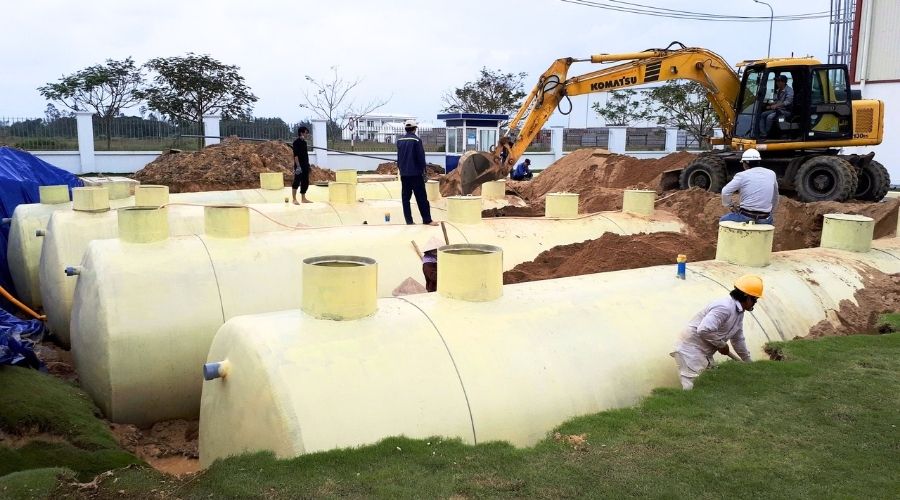
On-site wastewater treatment equipment is defined as equipment manufactured as a fully assembled single unit or a packaged module to treat domestic wastewater and meet environmental protection requirements under the regulation. Unlike works built directly on-site, equipment can be pre-manufactured as a whole unit or modular block before being transported to the site for installation.
This is also a point of note for packaged wastewater treatment equipment. Besides treatment efficiency, QCVN 98:2025/BNNMT also sets technical, conformity assessment, and management requirements before the equipment is introduced to the market. These details must be considered specifically for each case of manufacturing, importing, and supplying equipment.
.jpg)
Wastewater treatment equipment implemented by Dai Nam
QCVN 98:2025/BNNMT not only regulates the limit values for pollution parameters of post-treatment water but also sets requirements for the design, structure, installation location, and operating conditions of the works and equipment. According to the regulation, the processes of surveying, designing, manufacturing, constructing, installing, and commissioning on-site wastewater treatment works and equipment must comply with construction laws and other relevant legal regulations.
On-site wastewater treatment works and equipment must ensure structural safety and have suitable solutions to minimize impacts on the environment and users.
Some notable technical requirements include:
These requirements indicate that selecting the location and layout of the works and equipment needs to be considered right from the design stage, rather than focusing solely on wastewater treatment capability.
In addition to structural requirements, the works and equipment must have a wastewater treatment stage, an equalization stage, a clearance space above the water surface (freeboard), and an accumulated sludge storage zone as required by the regulation.
Among these, the clearance space above the water surface must have a minimum volume equal to 20% of the useful volume of the works and a minimum height of 0.2 m.
Regarding generated sludge, if the sludge storage zone is arranged as a separate compartment, it must ensure a storage capacity of at least one year. If not arranged in this format, there must be a solution to monitor the sludge volume and perform periodic sludge suction appropriate to the operation process.
Therefore, when applying QCVN 98:2025/BNNMT, evaluating the works or equipment is not only based on the output water analysis results but must also consider the structure, storage capacity, and conditions facilitating actual operation.
One of the vital components of QCVN 98:2025/BNNMT is categorizing post-treatment water quality requirements according to design capacity. Instead of applying a single general limit, the regulation divides works and equipment into different capacity groups to determine the corresponding requirements.
| Design Capacity | Post-treatment Water Quality Requirement |
| Less than 2 m³/day | According to Table 1 of QCVN 98:2025/BNNMT |
| From 2 to under 20 m³/day | According to Table 2 of QCVN 98:2025/BNNMT |
| 20 m³/day and above | According to Table 2 of QCVN 14:2025/BTNMT |
For a design capacity of less than 2 m³/day, Table 1 of QCVN 98:2025/BNNMT controls the parameters BOD₅, COD, and TSS. Organizations and individuals can choose to apply either COD or BOD₅.
For capacities from 2 to under 20 m³/day, the control scope is expanded to include pH, BOD₅, COD, TSS, Total Nitrogen, Total Phosphorus, animal and vegetable fats and oils, and Total Coliform. Similar to the group under 2 m³/day, organizations and individuals can choose to apply either COD or BOD₅.
For works and equipment with a design capacity of 20 m³/day and above, the treated wastewater must meet the limit values specified in Table 2 of QCVN 14:2025/BTNMT regarding domestic wastewater and wastewater from urban and centralized residential areas.
To visualize simply: a structure with a design capacity of 1 m³/day will be cross-referenced with Table 1 of QCVN 98:2025/BNNMT; a 10 m³/day structure with Table 2 of QCVN 98:2025/BNNMT; whereas a 50 m³/day structure must be cross-referenced with Table 2 of QCVN 14:2025/BTNMT.
Specifically, in cases where domestic wastewater is discharged into a centralized wastewater collection and treatment system, it must meet the connection requirements of that centralized system or the regulations of the provincial People's Committee.
Correctly determining the design capacity, therefore, not only serves the selection of technology and system sizing but also dictates which post-treatment water quality limit group must be applied.
On-site wastewater treatment works and equipment must be operated according to the instructions of the organization or individual that designed, manufactured, installed the equipment, or constructed the works. During use, it is necessary to regularly check the operational status, perform maintenance and servicing on electromechanical equipment, and monitor the structure, water level, and thickness of scum and sludge. Additionally, periodic sludge suction and troubleshooting/repairs must be carried out when incidents arise.
The monitoring and analysis of pollution parameters must be performed by an organization that has been granted a Certificate of eligibility to provide environmental monitoring services according to regulations.
For on-site wastewater treatment works with a capacity of less than 2 m³/day, if the treated wastewater is discharged into a receiving source, at least 01 post-treatment single sample must be taken. For works with a capacity of 2 m³/day and above, as well as for on-site wastewater treatment equipment, the number and frequency of post-treatment wastewater sampling are conducted in accordance with the legal provisions referenced by QCVN 98:2025/BNNMT.
Sampling is conducted after a period of no less than 30 days from the time the works or equipment starts receiving wastewater. Particularly for on-site wastewater treatment equipment, at the time of sampling, the treatment capacity must reach 100% of the design capacity.
The parameters to be monitored are determined by the corresponding capacity group: design capacities under 2 m³/day apply the parameters in Table 1 of QCVN 98:2025/BNNMT; from 2 to under 20 m³/day apply Table 2 of QCVN 98:2025/BNNMT; and 20 m³/day and above apply Table 2 of QCVN 14:2025/BTNMT.
If the testing results show that one of the pollution parameters exceeds the corresponding allowable limit value, it is necessary to check and adjust the operational process, design, or structure of the works/equipment, and perform re-sampling for testing.
On-site wastewater treatment works and equipment are evaluated as conforming to the post-treatment water quality requirements when all pollution parameters do not exceed their corresponding allowable limit values. The wastewater sample analysis results serve as the basis for evaluating treatment efficiency, compliance, and conformity with QCVN 98:2025/BNNMT; and also serve as the basis for the acceptance testing of the on-site wastewater treatment works before putting them into use.
Note the requirements in QCVN 98:2025/BNNMT
QCVN 98:2025/BNNMT stipulates that the declaration of conformity must be based on the self-assessment results of conformity by organizations/individuals or the conformity certification results issued by a certification body meeting regulatory conditions.
Specifically, for organizations and individuals manufacturing or importing on-site wastewater treatment equipment, the regulation mandates that conformity certification must be carried out according to Method 1 – Type Testing to evaluate conformity. The certificate of conformity is valid for no more than 03 years.
Before releasing the equipment to the market, manufacturing or importing organizations and individuals are responsible for checking, evaluating quality, and certifying conformity to the regulation; simultaneously, they must prepare and submit a conformity declaration registration dossier and execute the declaration of conformity to the specialized agency designated and assigned responsibility by the provincial People's Committee at the manufacturing location or importing locality.
To correctly determine the requirements for an on-site wastewater treatment works or equipment, it is first necessary to identify whether the facility falls under the application scope of QCVN 98:2025/BNNMT. The next step is to determine the type of wastewater, treatment form, design capacity, and the corresponding output water quality limit group.
For works and equipment within the scope of application, it is required to simultaneously consider requirements regarding structure, equalization, sludge storage, trash and grease separation, odor and noise control, as well as conditions facilitating inspection and maintenance. The design capacity must also be determined appropriately for the maximum generated wastewater volume as required by the regulation.
For newly built or renovated projects, considering these requirements right from the design phase helps in better selecting technological solutions, site layouts, and structural dimensions, while minimizing the need for adjustments after the system has been built or installed.
Particularly for on-site wastewater treatment equipment, organizations and individuals manufacturing, importing, or supplying the equipment need to fully review the technical requirements, treatment efficiency, conformity assessment, and management according to QCVN 98:2025/BNNMT before introducing the equipment to the market.
Users are responsible for selecting a qualified monitoring organization to take and analyze samples; accepting the works when requirements in Section 2 are met; and operating the works and equipment to ensure post-treatment water meets the corresponding limits.
QCVN 98:2025/BNNMT establishes a specific technical and managerial framework for on-site wastewater treatment works and equipment, covering everything from the scope of application, design, and structural requirements to capacity, post-treatment water quality, operation, and conformity assessment.
When applying the regulation, it is necessary to simultaneously determine the subject, wastewater type, treatment form, and design capacity to correctly select the corresponding requirements. Especially for new construction projects, renovations, or the use of packaged wastewater treatment equipment, considering QCVN 98:2025/BNNMT from the very beginning will help investors be more proactive in design, equipment selection, and system deployment.
Dai Nam provides consulting, design, and implementation services for wastewater treatment solutions tailored to the actual characteristics of each project and relevant environmental regulations.